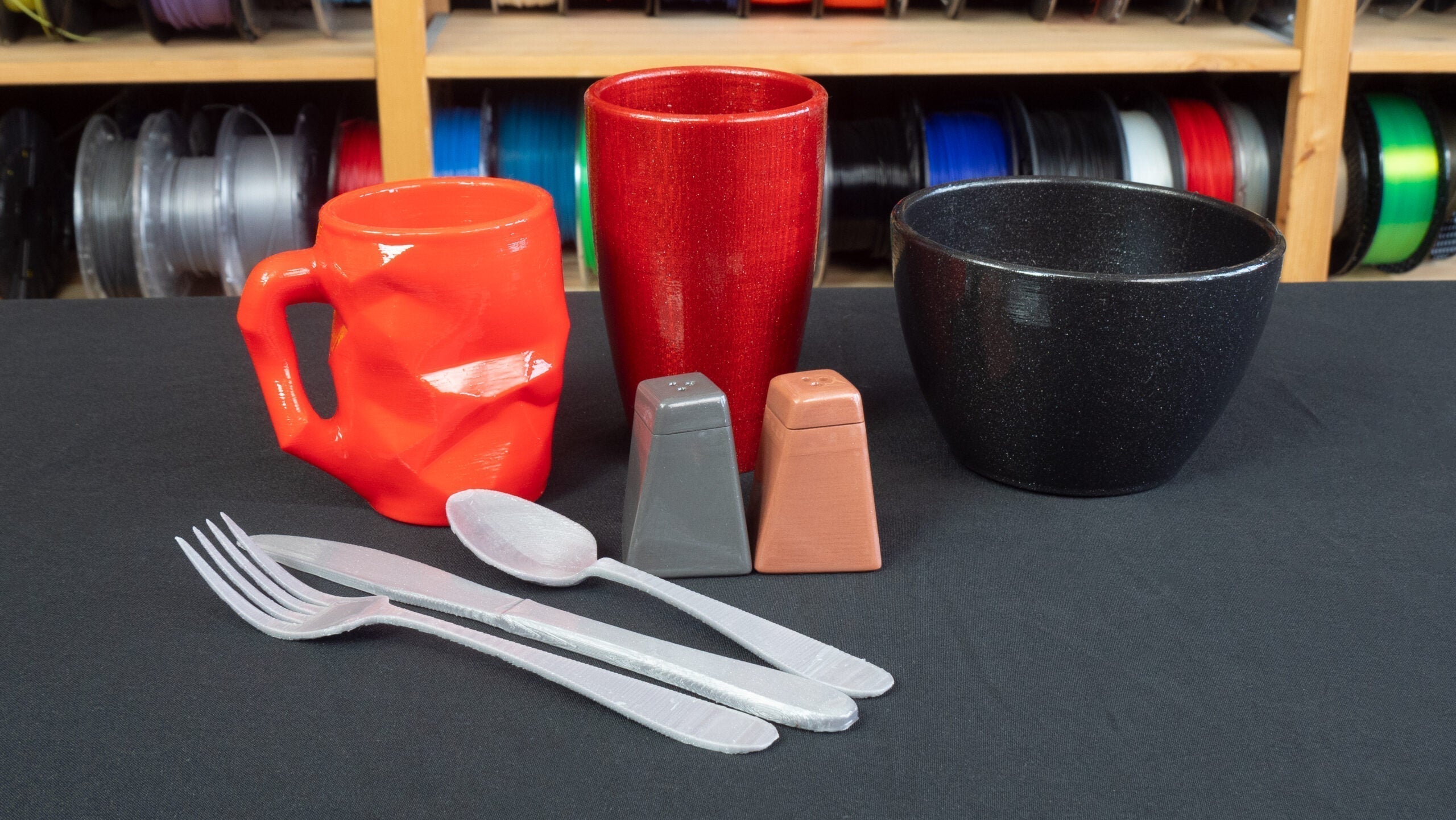
If you’ve ever searched for a custom cookie cutter or a replacement coffee machine handle, you’ve probably wondered: can I just print this? The short answer is no, not directly. But the real answer is far more nuanced, and most of what you’ll read online misses the point entirely. We run a print farm that regularly fields this question from customers, and our stance hasn’t changed: we will not market any filament or 3D-printed part as “food safe” straight off the printer. Here’s why, and what you can actually do if you’re determined to make something that touches food.
The Cross-Contamination Problem Nobody Talks About
A raw PLA pellet might be certified food safe in a laboratory. But the moment it runs through your printer, it’s no longer in a controlled environment. We print multiple materials on our machines PLA, PETG, ABS, ASA, filled nylons and even with purging, microscopic residues remain in the hotend, extruder gears, and PTFE tube. Cross-contamination is almost guaranteed unless you dedicate a single machine exclusively to food-contact prints and strip it of any non-food-grade components. Most home users and print farms can’t do that.
When a customer asks us to print a cup, a pet bowl, or a utensil, we politely refuse. The liability isn’t worth it. If they persist, we tell them the truth: this part would need to undergo its own food safety testing, such as ISO 22000 certification. Nothing that comes directly off an FDM printer can be assumed safe. For a thorough overview of the regulatory and material challenges, 3Dnatives has an excellent deep-dive into food-safe 3D printing that we often refer customers to.
Where We Draw the Line: A Personal Use Case
I’ve never eaten off an FDM print. But I have repaired kitchen tools. I once printed a replacement handle for a worn-out coffee tamper. The plastic handle never touches coffee or water; it simply provides a grip surface on a stainless steel shaft. That’s the line I’m comfortable with: indirect contact parts where the printed element is completely isolated from food. It’s a practical distinction that keeps broken tools out of the bin without gambling on safety.
The Bacteria Trap in Layer Lines
Even if you solve the material and contamination issues, the physical surface of an FDM print is a problem. Layer lines are microscopic canyons where moisture, food particles, and bacteria can hide. Washing by hand rarely cleans them completely. Dishwashers can soften the plastic or accelerate degradation.
The only method I genuinely trust to address this is post-processing with a food-safe clear resin coating. Several manufacturers produce epoxy or UV resins specifically certified for food contact once fully cured. A properly applied coating fills the layer lines and creates a smooth, non-porous surface that can be cleaned effectively. But this doesn’t fix the underlying material safety; it only seals it. The entire extrusion path hotend, nozzle, extruder gears must also be free of harmful leachates.
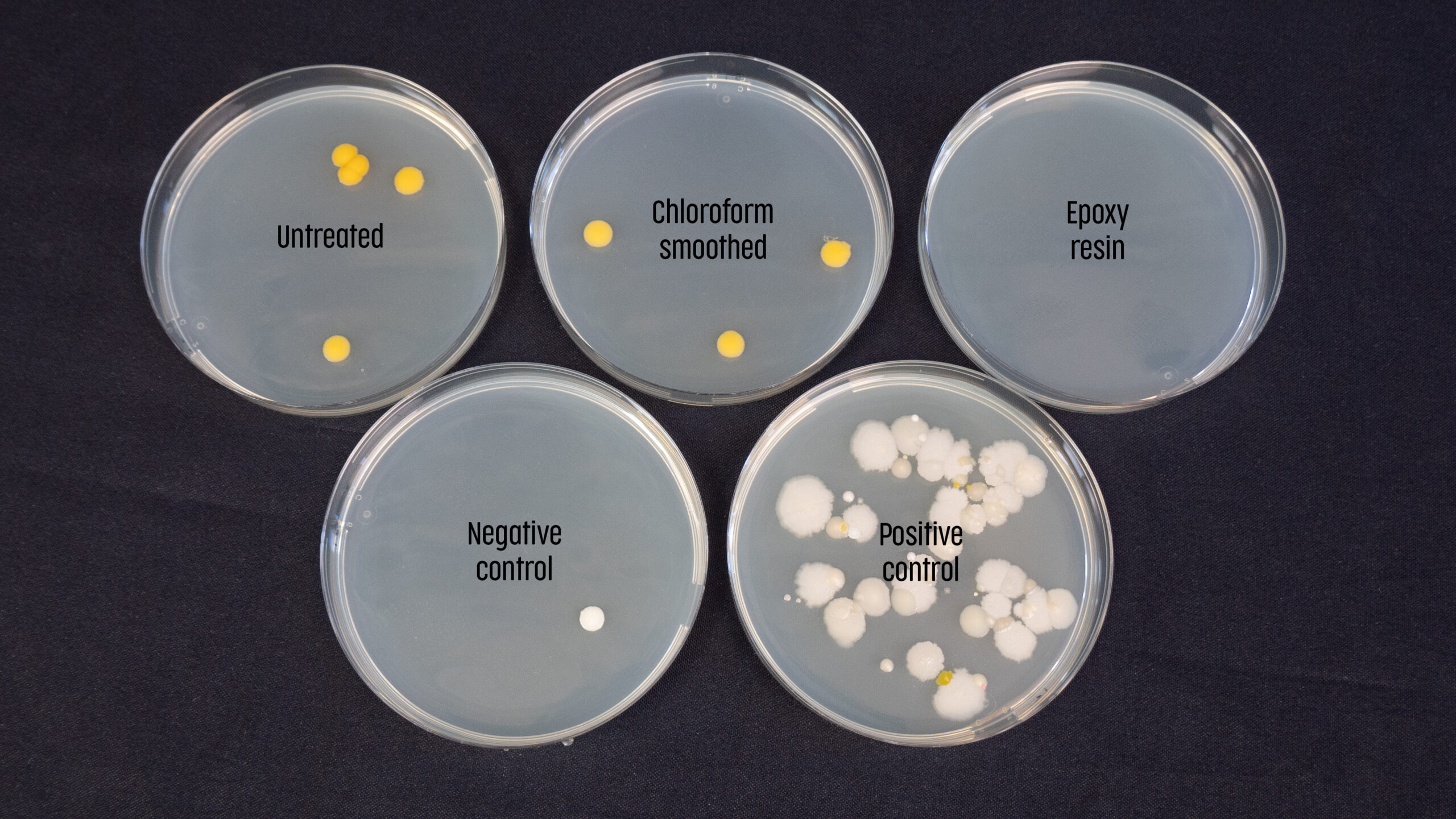
Image Source from Prusa: https://blog.prusa3d.com/how-to-make-food-grade-3d-printed-models_40666/
The Material Myth: “PLA Is Made from Corn, So It’s Safe”
This is the most persistent myth we hear. Yes, PLA is derived from renewable resources like corn starch. That doesn’t make it food safe in filament form. The moment a manufacturer adds colourants, impact modifiers, or flow enhancers, the safety profile changes. Almost no filament maker tests the final extruded product for food safety. They test the base resin, not the filament you actually print with. Those bright red or silk gold PLAs? The pigment and TPU additives have unknown food-contact status.
If you absolutely must use a filament for something that will touch food, and you’ve sealed it with a food-safe clear coat, stick with natural, uncoloured, unmodified PLA from a manufacturer that can provide a full safety data sheet. Even then, you’re accepting risk.
Then there’s the nozzle. Standard brass nozzles often contain trace amounts of lead to improve machinability. That lead can leach into the filament during extrusion. CNC Kitchen has documented lead-free brass options, but in general, stainless steel nozzles are the safer bet for any food-adjacent project. Copper, plated nozzles, and unknowns are not worth the gamble.
Our Policy as a Retailer
We do not sell any filament marketed as “food safe.” We provide technical data sheets and safety data sheets so customers can compare materials for their projects, but the intended end-use is their responsibility. Any part intended to be sold as a food-contact product must undergo its own independent testing and certification whether for food safety, toys, or industrial applications. We’re not the certifying body, and no hobbyist printer is either.
This stance has never been seriously challenged by a customer. Most simply didn’t realise the complexity. Once we explain the chain of contamination, the layer line issue, and the lead-in-brass risk, the “quick printed cup” idea loses its appeal fast.
The Bottom Line
FDM 3D printing is not food safe straight off the printer. Cross-contamination, porosity, unknown additives, and toxic nozzle metals make it a non-starter for direct food contact without extensive post-processing and dedicated equipment. With the right stainless steel hardware, natural uncoloured filament, and a properly cured food-safe resin coating, you can reduce the risk significantly but you’ll still own the liability. For most people, the smarter play is to use 3D printing for jigs, handles, and tools that never touch what they eat. Leave the plates and cups to traditional manufacturing.
Cover Image Source, from Prusa: https://blog.prusa3d.com/how-to-make-food-grade-3d-printed-models_40666/