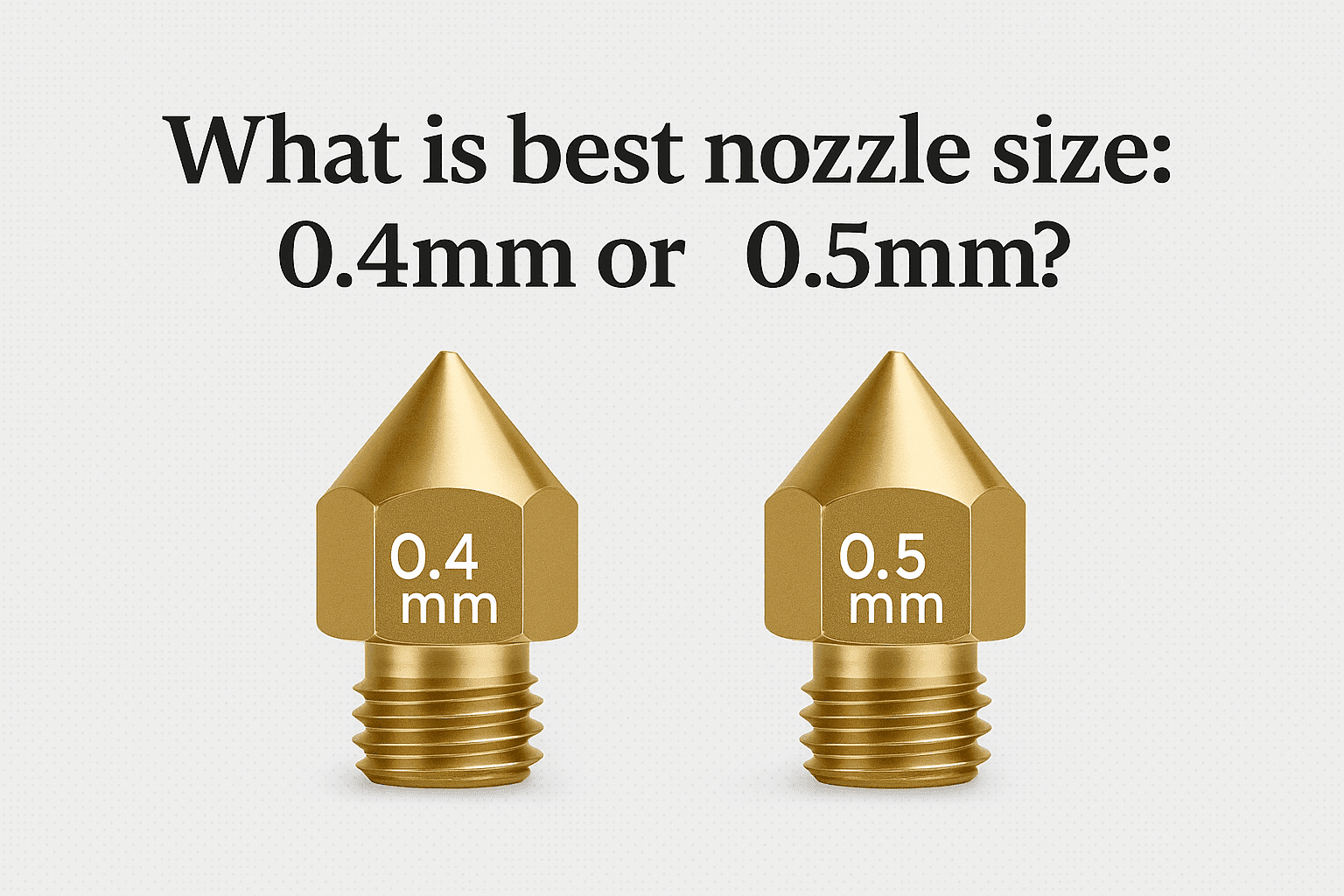
Most 3D printers ship with a 0.4mm nozzle. It’s been the industry default for so long that almost nobody questions it, until they buy a roll of carbon fibre filament and spend a weekend clearing clogs. The truth is, 0.4mm became the standard not through some grand engineering consensus, but because back in the early days, E3D Online drilled their nozzles in-house, and a approx 0.4mm drill bit is what they had on hand. That’s it. That’s the origin story of the size that shaped an entire industry.
At DREMC, we’ve been running 0.5mm nozzles as our default across every printer in-house for years now. We print parts for customers, we print Voron components, we print abrasive-filled engineering materials, and we’ve learned that the extra tenth of a millimetre delivers outsized benefits with almost no downside. Here’s the real-world case for 0.5mm, the rare situation where 0.4mm still wins, and the one modification we tried but don’t broadly recommend.
The Case Study That Convinced Us
We regularly print Voron functional parts for customers. These are components designed with tight tolerances, often originally intended for a 0.4mm nozzle. Over a long period of fulfilling these print-on-demand jobs, we made a deliberate decision to print them at 0.5mm. Not a single customer has ever complained about print quality, fit, or surface finish. The overhang performance didn’t degrade noticeably the way it does when you jump to 0.6mm, and the detail on smaller features remained sharp because the layer height can stay identical, you’re just laying down a wider line.

What did change was throughput. The ability to push more material in the same amount of time, particularly on infill and solid layers, translated directly into shorter turnaround times without sacrificing the mechanical integrity or aesthetics the customer expected. For a print farm, that’s not a trivial gain; it’s capacity.
More Flow, Stronger Parts, and a Hotend That Keeps Up
The obvious advantage of a larger nozzle is increased volumetric flow. But what surprised us is how much that extra flow benefits part strength. When you can deposit more material per second, you can increase infill density or wall thickness without blowing out the print time. Better layer adhesion, denser solid sections, and an overall stiffer part are the quiet beneficiaries.
Crucially, 0.5mm doesn’t overtax a stock hotend the way 0.6mm can with dense materials. We’ve seen some standard heater struggle to maintain temperature at high flow rates with a 0.6mm nozzle and filament that demands a lot of energy to melt. The 0.5mm sits in a thermal sweet spot, enough additional throughput to matter, not so much that you hit the melt-rate ceiling of a typical consumer hotend.
The Filled-Filament Advantage: Chopped Fibre Doesn’t Belong in a 0.4mm Orifice
For abrasive and filled materials, 0.5mm or larger is not a suggestion, it’s the safe floor. The chopped carbon fibre and glass fibre filaments we stock at DREMC can have individual fibre bundles that occasionally exceed 0.2-0.4mm in length. In a 0.4mm nozzle, those fibres don’t always pass cleanly. They accumulate, interlock, and form a partial blockage that gradually strangles extrusion. It’s not an instant failure; it’s a slow-motion clog that degrades print quality over tens of hours until the user blames the filament, or when you switch to lower temperature materials without complete purge.
In a 0.5mm nozzle, the same fibres slip through without building up but we will recommended purging enough when switching materials. Note that this issue is specific to chopped-fibre materials; milled-fibre filaments have smaller, more uniform particle sizes and don’t pose the same clogging risk, but they also deliver different mechanical properties. For the chopped fibre that dominates the high-strength market, stepping up to 0.5mm keeps the printer printing.
The speed dividend is real too. Using the same speed profile as a 0.4mm nozzle, a 0.5mm nozzle will typically print 20–30% faster on the same part. In a farm, that’s a 20–30% increase in throughput without changing a single other variable.
The Bambu Drilling Experiment (And Why We Don’t Recommend It)
When the original Bambu Lab X1 shipped without removable nozzles, we found ourselves in a bind. Bambu only offered 0.4mm and 0.6mm and no 0.5mm. So we drilled one.
Yes, manually. With a 0.5mm drill bit, carefully, on a press. The results were actually good. The stock hotend could keep up with the flow, we saw fewer clogs with filled materials than the 0.4mm, and it avoided the melt-capacity limits we ran into with the 0.6mm on dense engineering filaments. But here’s the thing: we don’t recommend it. Bambu’s ecosystem is built around a plug-and-play promise, and drilling your own nozzle voids that. If you’re running a newer model with interchangeable V6-style nozzles, just swap in a proper 0.5mm and skip the drill press entirely. The lesson stands, but the method is a last resort, not a guide. Now we have some diamond for TZ hotend for testing from Fabreeko, which is great as we use varying TZ version on our hotend to test product we stock, to replace our standard 0.5mm TZ that we batch order a while ago but many manufacturer have stop offering.
The One Question That Instantly Picks the Right Nozzle
When a customer stands in front of the nozzle drawer unsure, I ask them one thing: Do you plan to print large parts or use filled materials like carbon fibre or glass fibre?
If they say yes to either, the recommendation is 0.5mm without hesitation. It handles filled filament without clogs, it speeds up large prints, and it costs nothing in practical detail. If they’re printing only small, highly detailed miniatures or Hueforge prints where every micron of lateral resolution counts, 0.4mm or smaller 0.2mm is still the sensible tool but that’s a narrow sliver of the market.

Photographed Model: Abstract
We reinforce this with the profiles we provide. Because we run 0.5mm as default in-house, our tuned SuperSlicer profiles are built with percentage-based settings wherever possible, so you can swap nozzle sizes and have a solid baseline without starting from scratch. It’s a work flow choice born from living with 0.5mm every day, and it makes supporting customers much simpler.
The Future: Will 0.5mm Ever Become the New Default?
I think we’ll see a slow shift. Larger-format printers shipping with a 0.5mm nozzle out of the box would be a logical evolution, and it would push manufacturers to provide official filament profiles for that size. That’s the bottleneck: tuning an extra nozzle size takes resources, and most companies won’t do it unless the demand is deafening.
But the historical reason for 0.4mm, a drill bit that happened to be lying around a workshop, shouldn’t dictate what we use forever. A 0.5mm nozzle is a better default for the way people actually print today: larger beds, filled materials, higher flow rates, and less patience for slow functional parts. It’s not a radical departure. It’s a tenth of a millimetre. And over a few hundred print hours, that tenth adds up to a real advantage.