If you’re reading this, you’ve probably already pushed your Anycubic Kobra 3 hard enough to hit its limits. The stock hotend works. Until it doesn’t. It’s a PTFE-lined hotend that will serve you faithfully for PLA, PETG, and the occasional TPU right up until the moment the PTFE tube degrades, heat creep sets in, and a perfectly sliced file becomes a blob of wasted plastic.
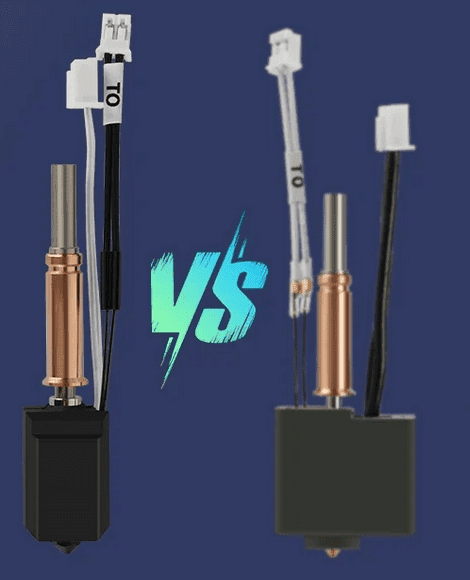
At DREMC, we’ve been shipping the Ceramic Hotend TZ as the direct answer to those failures. The value proposition is almost suspiciously good: the upgrade costs the same as a stock replacement, but introduces an all-metal heat break, a ceramic heating core, and a hardened steel nozzle. On paper, you’re trading a consumable for a long-life component. In practice, the switch requires a little more care on the bench than the marketing implies and once fitted, it locks you into a new nozzle ecosystem. Here’s the honest, hands-on comparison.
The Drop-in That Demands a Delicate Hand
The Ceramic Hotend TZ is sold as a drop-in replacement, and physically it is. But drop-in doesn’t mean brainless. The single most common step customers get wrong and the one that can turn a $35 upgrade into a paperweight is hot tightening the nozzle.
The ceramic heater is efficient, but its and brittle. When you clamp the hotend to torque the nozzle, every Newton of force you apply to the wrench must travel into the heater block through the metal body and not through the ceramic element. Let the wrench contact the ceramic body even slightly under load, and you’ll crack it. We’ve seen it happen. The hotend will then fail to reach stable temperatures, or worse, fail silently mid-print.
Our bench rule is simple: when tightening, hold the heater block with a spanner, not the ceramic housing. If your wrench slips and pressure point, it should meet metal, not ceramic. That extra minute of careful alignment is the difference between a dead hotend and a year of reliable printing.
Hundreds of Upgrades Later: What We’ve Actually Seen
We’ve personally sold hundreds of the TZ ceramic hotends for the Kobra 3. The failure rate is markedly lower than the stock PTFE-lined assembly, and the reason is mostly the all-metal heat break. No PTFE means no gradual charring at the throat, no slow constriction of the filament path, and no sudden heat-creep jams that coincide with a 36-hour print’s final layers.
The bundled hardened steel nozzle is the quiet hero. Compared to the stock brass nozzle, it wears at a fraction of the rate. For anyone printing abrasive PLAs, glow-in-the-dark, or even just a lot of PETG, the nozzle’s longevity removes a variable that silently ruins dimensional accuracy.
The trade-off is thermal. Because you’re replacing a PTFE-lined path with an all-metal one, you’ll likely need to add 5–10°C to your old profiles. Users who skip this step will see under-extrusion and blame the hotend with older sliced files or profiles.
In terms of print quality, the difference is marginal for small, intricate parts. For large, flat prints and for high-flow scenarios (0.5mm nozzle, dense infill), the ceramic version of the hotend can sometimes not holds temperature due to smaller thermal mass, leading to sometimes less consistent surface finish with larger nozzles, although its really limited by heater output that supported by stock printer.
The Honest Trade-Offs (Yes, There Are Some)
For all its strengths, the Ceramic Hotend TZ has two non-negotiable quirks:
-
Assembly is required. The stock hotend comes fully built. The TZ demands you fit the nozzle, tighten it hot, and route the wiring yourself. If you’re a user who never wants to touch a spanner, the stock hotend is the path of least resistance.
-
You leave the Anycubic nozzle ecosystem. The TZ uses a specific, shorter nozzle, Anycubic’s stock Kobra 3 nozzles will not fit. In the future, when you need a replacement, you’ll be ordering a TZ-specific nozzle. That’s not a hardship (we stock them), but it’s a lock-in you should know about before you buy.
Are there scenarios where the stock hotend is still the right choice? Honestly, if you’re printing purely non-abrasive PLA at standard speeds, and you value the ability to swap anycubic kobra 3 specific nozzles with whatever is locally available, the stock hotend still functions. But for everyone else, anyone who wants a set-and-forget solution that eliminates PTFE degradation, handles abrasives, and costs exactly the same as the part it replaces, the ceramic hotend is the better long-term call.