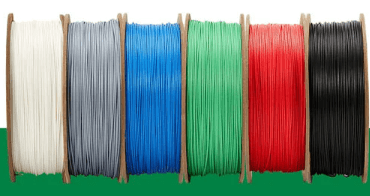
Walk into any filament store and you'll drown in options. PLA, PLA+, PETG, TPU, Silk, High-Flow, ABS every label promises to be the one you need. The reality is far simpler, and you can ignore most of it if you understand a few core truths that most beginner guides won't tell you. After years of running printers, supporting customers, and dealing with the failed prints that came in the door, here's the real beginner's path through the filament jungle.
The Trap Almost Every Beginner Falls Into
Hands down the most common assumption I see is: "PETG is stronger than PLA." On paper it sounds right. PETG has higher impact resistance, right? So beginners buy a roll of PETG for a functional bracket, print it, and when it slowly bends out of shape under a constant load, they blame the design or the printer.
Here's the truth you need early: PLA is stiffer and often stronger in static load than PETG. It holds its shape without creeping, which makes it fantastic for fixed installs, brackets, and prototypes that need to maintain a dimension. The trade-off is that PLA is brittle, when it fails, it fails spectacularly, snapping rather than bending. PETG will flex and yield. So if the part gets smacked around, dropped, or cycled, PETG's malleability becomes a strength, not a weakness. Almost every beginner under-thinks the temperature limitation of both. PLA starts to soften disturbingly early, a car interior on a warm day will kill it. PETG holds up better but still doesn't belong under a bonnet. If you remember nothing else, remember this: stiffness and heat are the two silent part killers nobody warns you about.
The Only Three Spools a Beginner Needs
Don't buy a rainbow of exotic filaments on day one. If you have a basic, open-frame printer without an enclosure, the kind most people start with, I'd put exactly three spools in your hands, in this order:
1. PLA (standard, from a reputable brand). Start here. Modern PLA blends print effortlessly on almost any machine with the default generic profile the manufacturer provided by printer. You don't need a custom tuned filament preset. PLA teaches you what a good first layer looks like, what stringing isn't, and how your printer behaves when everything is easy. Use it for prototypes, indoor decorative prints(its has range of colours), and anything that won't see heat or impact.
2. PETG. Once you've printed a dozen successful PLA parts, load up PETG. It will teach you about bed adhesion (some surfaces need a release agent), slightly higher temperatures, and how a material that loves to string can still be your best friend. PETG is your go-to for anything that needs to handle a bit of flex, repeated handling, or slightly elevated warmth, but still nothing near a heat source.
3. TPU (flexible). This is the wildcard that rounds out a truly useful starter set. TPU is for when you need a part that must bend: phone case bumpers, vibration-damping feet, gaskets, drone skids. Modern TPU prints on direct-drive and even many Bowden open printers if you take the speed down. The default profiles on a Prusa or Bambu will give you a decent first print. TPU shows you the opposite end of the stiffness spectrum and unlocks a category of functional parts neither PLA nor PETG can touch. Its also one most tough materials (when printed right), you can try softer or harder depending the application but its one stronger materials (ie its will re-bound back to nature state).
This trio is the sensible core. You don't need to jump into ABS, ASA, or filled nylons until you have an enclosure and a specific thermal or mechanical problem to solve.
How to Actually Decide Which Material to Use
Forget memorising numbers you don't understand yet. I teach people a dead-simple set of questions that covers 90% of beginner decisions:
Does the part sit still, hold something, or need to stay exactly the same shape under constant pressure? Use PLA. It's stiff, doesn't creep, and will hold a thread if you design for it. Example: a headphone wall hook, a shelf peg, or a prototyping jig.
Will the part be flexed, snapped on and off, or dropped a few times? Reach for PETG. It'll take the abuse without shattering. Think snap-fit enclosures, drone landing gear, or a clip that has to survive heavy-handed use.
Does the part need to survive a hot car, direct sun, or a heated enclosure? Now you've left the beginner zone, and neither PLA nor standard PETG is a safe bet without real testing. But for quick indoor functional parts, PLA and PETG will carry you a long way. You may need look to more semi engineering materials likes ABS/ASA and more advance filaments.
One more tip that saves endless frustration: if you're downloading a design from Printables, Thingiverse, or MakerWorld, read the designer's description. Most good designers tell you exactly the material the file was designed for and the print orientation they tested. Ignore that and you're an unpaid beta tester.
Cheap Filament and the Quality You Actually Pay For
The filament market today is dramatically better than it was a few years ago. Beginners will often chase a persistent under-extrusion, inconsistent surface finish, or random clogging and blame the printer for a week straight (this may be cause a couple years ago with older printers). Then they swap to a decent filament and the "printer problem" vanishes.
The tell-tale culprit is usually inconsistent diameter, contamination, or a spool wound so badly it snags mid-print. The cheapest filaments may also use a cardboard or plastic spool that jams in an AMS or CFS multi-material system due to poor spooling from the factory or "bad spool" ie usually first 1-2 spool when machine get filament to accurate size that should not be sold are sold to customers.
If you want peace of mind, buy from a manufacturer with a solid track record of after-sale support this kind that will replace a spool outright if it's a manufacturing fault. I've seen Polymaker do this without fuss, and there are a few others. Look for a brand that stands behind its product, not a random marketplace listing with a cryptic name. And always double-check that you're buying a full 1kg spool, not a sneaky 250g or 500g sample, unless that's exactly what you want. For multi-material users, confirm the spool dimensions are compatible with your AMS/CFS before you hit buy.
Two "Easy" Filaments That Lie to Beginners
Silk PLA is not just shiny PLA. That silky, glossy finish comes from additives, typically an elastomeric component like TPU blended in. This makes Silk PLA more sensitive to moisture, more fussy about temperature, and wildly more susceptible to speed changes. Print it too fast or too hot, and you lose the shine and end up with a part that's significantly weaker than standard PLA. It's marketed as "just as easy" but the first time you get a stringy mess or layer adhesion failure, you'll understand why it deserves its own profile and a slower hand. Treat Silk as its own material, not a colour variant.
"High Flow PLA" is a marketing term that needs scrutiny. The raw material cost difference is tiny, and modern standard PLA formulations can already print at perfectly high speeds on a stock consumer machine without special flow additives. Before paying a premium, take a look at the product's Safety Data Sheet. Some high-flow blends achieve their flow rate by introducing additives that, in an enclosed space with no filtration, you may not want volatilised in your room. If a reputable manufacturer's standard PLA already prints flawlessly at the speeds your printer is capable of, that high-flow spool is a solution to a problem you almost certainly don't have.
Start with PLA, add PETG, then grab TPU. Learn them before you drift into anything more exotic. The printing skill you build on that simple trio will stop you wasting money on fancy spools you aren't ready to handle, and your first functional prints will actually work instead of failing in mysterious ways you haven't yet learned to read. If you still have question, feel free to reach out us.