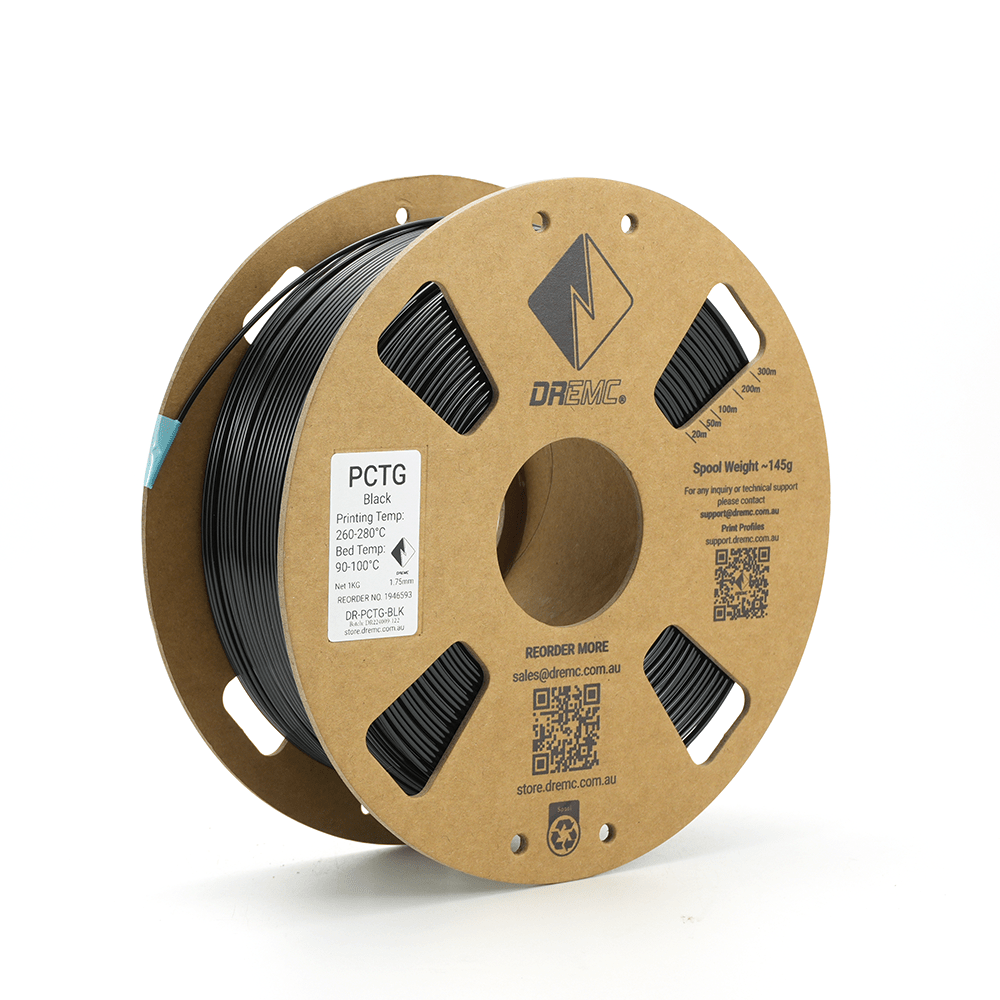
If you're exploring the differences between PETG and PCTG, you're in the right place. This guide outlines their key performance attributes such as strength, durability, and chemical resistance to help you choose the ideal 3D printing filament for your upcoming high-demand projects.
TLDR: PCTG beats PETG on temperature resistance (slightly higher HDT, around 74 degrees Celsius), chemical resistance (survives IPA and solvents that degrade PETG), and UV resistance. It also prints with less stringing and similar ease on the same open-frame printers. Choose PCTG for demanding functional parts; choose PETG if you need a wider colour range or lower cost. Filled PETG CF/GF variants trade away the toughness that makes PETG and PCTG valuable in the first place.
If you have been printing PETG for years, you already know why it earned its place as the default step up from PLA. It is tough, forgiving, resistant to many chemicals, and it prints on almost any machine without an enclosure. But there is a material gaining real traction in the 3D printing community that keeps everything you like about PETG and pushes the performance further. That material is PCTG.
Selecting the right material is crucial in additive manufacturing. Among the popular choices for FDM printing are PETG (polyethylene terephthalate glycol-modified) and PCTG (polycyclohexylenedimethylene terephthalate glycol-modified). Both filaments are often compared for their durability, printability, and versatility across various 3D printing applications. While PETG is well-established in the 3D printing community, PCTG is gaining traction as a more robust alternative for parts that require greater performance than standard PETG can provide. If you’re curious about what sets PCTG apart, we’re here to clarify and help you understand its advantages.
At a molecular level, both PETG and PCTG are classified as glycol-modified polyesters, but they differ in the specific glycol used. PETG can incorporate either CHDM (cyclohexane dimethanol) or NPG (neopentyl glycol) to enhance clarity and reduce brittleness. In contrast, PCTG contains a higher concentration of CHDM, often exceeding 40%—which significantly boosts its impact resistance, ductility, and chemical resilience. These molecular distinctions make PCTG a superior option for engineering and functional components, especially those subjected to mechanical stress and harsh environments. This scenario is similar to comparing ASA to ABS, where ASA provides similar ease of printing but excels in weatherability and UV resistance, making it better suited for outdoor or demanding applications. Although both filaments belong to the PET family, PCTG is frequently viewed as the next-generation upgrade, offering enhanced toughness without sacrificing the ease of printing characteristic of PETG.
Performance Comparison: PETG vs PCTG
Here is how the two materials stack up on the numbers that matter.
| Property |
PETG |
PCTG |
|---|---|---|
| Tensile Strength | Around 40 MPa | Around 45 MPa |
| Flexural Strength | Around 65 MPa | Around 75 MPa |
| Heat Deflection Temperature (ISO 75, 0.455 MPa) | Around 65 degrees Celsius | Around 74 degrees Celsius |
| Chemical Resistance | Good, better than ABS | Better, survives IPA and more solvents |
| UV Resistance | Moderate | Better than PETG |
| Impact Resistance and Ductility | Good | Higher CHDM content gives superior toughness |
| Printability | Excellent | Excellent, with less stringing |
| Moisture Absorption | Medium | Low |
| Printing Odour | Minimal | Minimal |
The tensile and flexural strength gains are real but not dramatic. Where PCTG pulls ahead is in toughness, ductility, and its ability to resist the things that slowly degrade a part over time. That is why we consider it an engineering-grade upgrade rather than just a slightly stronger PETG.
In the rapidly evolving realm of 3D printing, material innovation is key to maintaining a competitive edge. By embracing advanced materials like PCTG, professionals and engineers can achieve higher mechanical performance without compromising the printability and versatility typically associated with PETG. Whether you're developing functional prototypes, jigs and fixtures, or end-use components, PCTG offers the toughness, chemical resistance, and dimensional stability that surpass what PETG can deliver. For those at the forefront of filament technology, PCTG is not merely an alternative; it’s an essential upgrade for your additive manufacturing process.
That said, PETG continues to be a reliable filament for a range of prototyping and low-stakes applications. If your project doesn’t require the enhanced toughness or chemical resistance PCTG provides, DREMC’s modified PETG remains a trusted performer. Additionally, for specialised engineering requirements, DREMC offers various filled PETG options, including PETG+CF / PETG+GF for increased stiffness. Whether you need a dependable standard filament or a solution tailored for a specific challenge, DREMC has performance-driven filament options to meet your requirements.