Walk into any 3D printing enthusiast’s workspace, and you will almost certainly see a spare brass nozzle on the desk. Despite the growing popularity of hardened steel and more exotic options like diamond, ruby‑tipped, and even tungsten nozzles, the vast majority of new printers from budget Creality machines to premium Voron kits still ship with a standard brass or plated copper nozzle. Why?
TDLR: Manufacturers ship brass or stainless nozzles not because they are outdated, but because they are still the best all‑rounder for the majority of users and use cases. With high‑flow hotends demanding efficient heat transfer, brass’s or stainless steel thermal properties remain highly relevant. And with the availability of hybrid tips is now becoming the standard when enabled both abrasive resistant and better thermal properties for better materials flow.
Let’s break down the engineering, economics, and practical reasons behind this seemingly old‑school choice.
Thermal Performance: Brass Excels at Heat Transfer
Brass is not just cheap; it is exceptionally good at conducting heat. Its thermal conductivity (~109 W/m·K) is significantly higher than hardened steel (~15 W/m·K) (Source: Hyperphysics). For a printer manufacturer, the priority is first‑layer adhesion, consistent extrusion, and minimising clogs right out of the box. Brass heats up faster and responds more quickly to temperature changes, which translates to reliable, repeatable prints with common materials like PLA, PETG, and ABS.
With the recent shift towards high‑flow hotends (e.g., Creality K1 series, Bambu Lab X1/P1, E3D Revo High Flow), the ability to melt filament rapidly becomes critical. Brass’s superior thermal conductivity helps maintain high volumetric flow rates without raising temperatures to unsafe levels. A hardened steel nozzle might last longer, but it can reduce maximum flow by 10–20% compared to an otherwise identical brass nozzle. Also older nozzle design have relative thicker nozzle walls.
Material Flow Properties: Brass Is “Slipperier”
Filament flow is not just about temperature – it is also about surface interaction. Brass has a naturally lower coefficient of friction with most thermoplastics than steel (Source: Engineeringtoolbox). This means PLA, PETG, and especially soft materials like TPU glide more easily through a brass nozzle, reducing the risk of “stick‑and‑slip” artefacts and inconsistent extrusion. For a printer manufacturer shipping a machine that must work with dozens of filament brands, brass is the safest, most forgiving choice.
Cost vs. Wear: Most Users Don’t Need Hardened Steel
Abrasive filaments – carbon fibre, glow‑in‑the‑dark, metal‑filled, glass‑filled, represent only a tiny fraction of total filament sales in 2024. The average user prints PLA, PETG, or ABS, none of which wear down a brass nozzle quickly. A standard 0.4mm brass nozzle can easily last 6–12 months of regular use before showing any noticeable change in orifice shape. Although demand for those abrasive materials is becoming popular in both hobbyist compare to previously only Industrial users.
From a manufacturer’s perspective, adding a hardened steel nozzle would increase the bill of materials (BOM) by ~$5–10 per printer which is a significant cost when shipping tens of thousands of units. That money is better spent on better motion systems, mainboards, or firmware.
The New Hybrid: Hardened Steel Tip, Brass/Copper Body
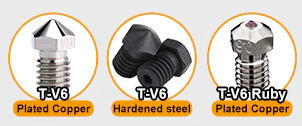
A recent innovation addresses the wear issue without sacrificing thermal performance: nozzles with a hardened steel insert or tip, while the rest of the body remains brass or plated copper. Examples include the E3D Nozzle X, Slice Engineering Vanadium, and many aftermarket “bimetal” nozzles. This design offers excellent abrasion resistance exactly where it is needed, at the orifice while keeping the high thermal conductivity of brass for the main body.
However, these hybrid nozzles are still more expensive to produce. Printer manufacturers largely continue to ship with monolithic brass or copper‑plated nozzles because they are proven, cost‑effective, and good enough for the vast majority of users. They leave the decision to upgrade to the end user, who can later purchase a hardened steel or hybrid nozzle if and when they start printing abrasives.
Nozzle Material Comparison (Quick Reference)
| Material | Thermal Conductivity | Wear Resistance | Best For | Typical Cost |
|---|---|---|---|---|
| Brass | Excellent | Low | PLA, PETG, ABS, TPU (non‑abrasive) | $ |
| Copper Plated | Very good | Low–Medium | High‑temp filaments (ABS, ASA, PETG) | $–$$ |
| Hardened Steel | Poor | Excellent | Abrasive filaments (CF, glow, metal) | $$ |
| Ruby / Diamond Tip / Harden Steel | Good (steel body) | Very high | Long‑life abrasive printing | $$-$$$ |
| Tungsten | Excellent | Very high | Abrasive filaments + torching clean | $$$$ (~90–120 AUD) |
So, Should You Upgrade Immediately?
No. Use the stock brass nozzle first. Learn your printer’s behaviour, dial in your slicer settings, and enjoy trouble‑free printing. Only switch to a hardened steel, tungsten, or hybrid nozzle if you plan to print abrasive materials regularly or if you notice your brass nozzle’s orifice has enlarged (visible as inconsistent lines or stringing).
If you need a drop‑in replacement that offers better durability without losing too much thermal performance, consider a plated copper nozzle (e.g., Micro Swiss or Trianglelab). It sits between brass and hardened steel in both cost and characteristics.
Final Thoughts
Manufacturers ship brass nozzles not because they are outdated, but because they are still the best all‑rounder for the majority of users and use cases. With high‑flow hotends demanding efficient heat transfer, brass’s thermal properties remain highly relevant. And with the availability of hybrid tips, you can always upgrade later.
At DREMC, we stock a full range of nozzle materials from economical brass to high‑end tungsten and diamond, so you can choose what fits your printing journey. Browse our 3D Printer Nozzles collection or contact us for personalised advice.