
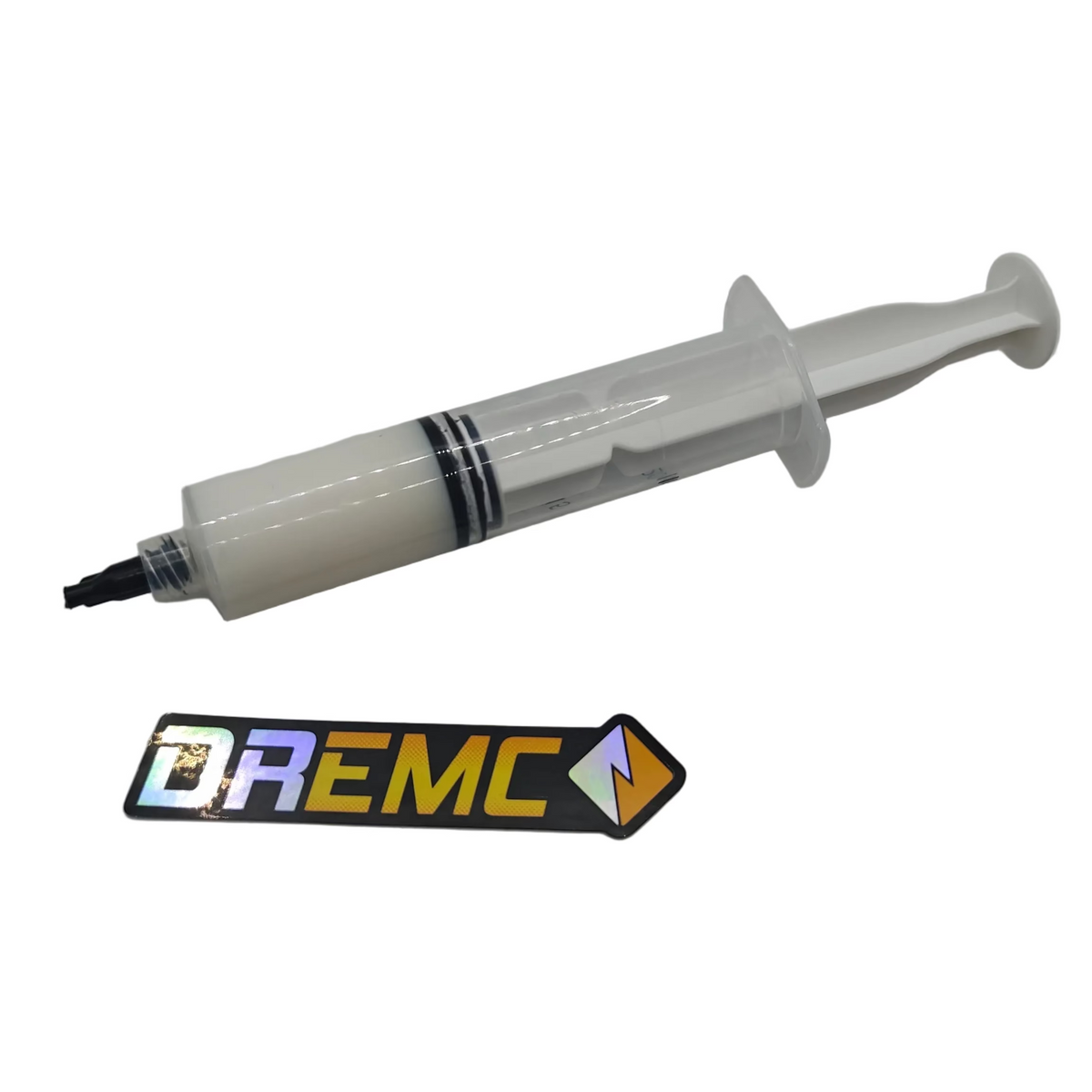
Search any 3D printing forum for lubrication advice and you will find a dozen conflicting answers. Some people swear by white lithium grease from the hardware store. Others say any old PTFE spray will do. A few insist oil is the only correct choice for linear rails. We have tested most of these options on our own machines, and we have also replaced a lot of linear rails for customers who followed that advice.
Here is what we actually run, why it works, and the mistakes that quietly destroy your motion system over months rather than days.
TLDR: Use a high speed linear grease like NSK GRS PS2 on your linear rails. Never use PTFE or solid-additive greases on recirculating ball rails because they build up and destroy the block. Oil flows with gravity and leaves uneven protection, so treat it as a stopgap only. Never mix greases with different base chemistries. Keep dust away from your rails, inspect and top up grease every one to two months(every 100kms), and expect to fully disassemble and clean before re-greasing occasionally if you live in duty environment or find rails getting gritty fast. PTFE grease is fine for lead screws, just not for rails.
What we actually use in our 3d printers
We started where most people start. Cheap grease from eBay. Whatever the local hardware store had on the shelf. WD-40 branded options. None of it lasted, and some of it caused more problems than it solved.
Once we moved to higher quality rails from Hiwin, TBI, NSK, and THK, we switched to the grease those manufacturers recommend or their own branded formulas. There is a real reason for this. Linear greases come in a wide range of formulations built around different base soap types, grades, viscosities, and intended applications. The right one depends on your load, your speed, and your environment.
Our default these day is NSK GRS PS2 or older Hiwin G02. NSK is a Japanese-made grease designed specifically for high speed applications, and that matches what modern 3D printers actually do. In 3d printing rails move fast and reverse direction constantly. The loads we put on them are nowhere near the rated limits of a quality linear block, so the limiting factor is not load capacity. It is speed and heat. A grease built for high speed keeps the ball bearings moving freely without the drag that a thick, heavy grease introduces.
The other reason we settled on it is availability. It is easy to source consistently and better value, which matters when you are maintaining a fleet and recommending a product to customers.
The PTFE additive trap
This is the mistake we see most often, and it is expensive to fix.
Never use a grease that contains solid additives like PTFE on your linear rails(Source). Those additives feel smooth going on, but over time they build up inside the recirculating ball channel. The grease carrier separates or dries out, and the PTFE particles are left behind as a gummy residue that gradually restricts the balls and increases friction. By the time you notice the roughness, the damage is done. You cannot flush it out easily. You either disassemble the block, which is fiddly and risks losing balls, or you buy a new rail and block set.
PTFE greases are fine for lead screws. Lead screws are simple sliding interfaces, they do not have a recirculating ball path to clog, and cleaning them is a quick wipe and reapply. If you have a tube of PTFE grease, keep it for your Z axis. Keep it away from your linear rails.
Oil vs Grease: The gravity problem
The common advice is oil for high speed rails and grease for lead screws. We do not follow that, and here is the practical reason.
Oil flows. It obeys gravity. In a linear block, the ball bearings contact the raceway at multiple points around the circumference. An oil film will pool at the bottom of the block and drain away from the upper contact surfaces. That means the top of your rail is running with less protection than the bottom, and the wear is uneven. You will not notice it until the rail develops a rough spot or the carriage starts to bind under fast direction changes.
Grease stays where you put it. A good high speed grease has enough structural integrity to remain distributed across all the contact surfaces without running off. That gives you consistent wear protection in every orientation, which matters because most printers have rails mounted vertically, horizontally, and at various angles.
If oil is all you have on hand, use it. It is better than a dry rail. But treat it as a stopgap, not a solution. Plan to clean it out and switch to grease as soon as you can.
Never mix your greases
This one catches people out because it seems harmless. You have a rail that shipped pre-lubricated from the factory. You buy a tube of grease and top it up. Six months later the carriage feels rough.
Different greases use different base chemistries. Some are lithium-based, some are calcium-based, some use more exotic soaps. When you mix two incompatible greases, the base soaps can react with each other and break down the lubricant film. The result is a runny mess that offers almost no protection, or a thick sludge that increases friction.
If you want to use your own grease, you need to know what is already in the rail. Some rails ship dry. Some ship with a storage or preventative grease that is only intended to protect the rail during shipping, not to serve as a working lubricant. Some ship pre-lubricated with a specific formula from the manufacturer.
If you do not know what is in there, clean it out first. Flush the block with a compatible solvent, let it dry, and then apply your chosen grease. It takes an extra twenty minutes. It saves you replacing a rail.
The overlooked maintenance item: Cleanliness
The single most important thing you can do for the life of your linear motion system is not choosing the perfect grease. It is keeping dust and debris away from the components.
Dust is abrasive. It mixes with grease and turns it into a grinding paste. In a workshop environment, especially one where you are sanding, cutting, or working with carbon fibre, dust finds its way into everything. Once it is inside a linear block, no amount of fresh grease will fix it. You have to take the motion system apart, clean it properly, and re-lubricate.
We inspect our machines every one to two months. The interval depends on usage, but also on temperature, humidity, and how dusty the environment is. A machine in a clean, climate-controlled room will hold its grease much longer than one in a garage workshop with the door open.
During each inspection, we check for dust build-up around the rail and block, look for any sign of grease drying or migrating, and top up if needed. At some point, topping up is not enough. You will need to disassemble, clean, and re-grease from scratch. Knowing when to do that comes down to feel. If the carriage has a slight gritty sensation or the grease looks discoloured and thick, it is time, as typically grease are white/semi transparent so its much easier to see build up for dirt, materials etc. Grease itself starts off white when new, and as the equipment operates it turns yellow or orange, which are complementary colours of blue. The grease continues to change colour with operation, eventually becoming black, which indicates zero remaining life.

Why we stock what we stock
There are a lot of places selling generic grease. We chose to stock NSK GRS PS2 because it is designed for high speed applications, it has worked reliably in our own printers, and it is not something you can pick up at the local hardware store.
We sell it in 80 gram retail tubes, but we also break it down into smaller packs 9 grams syringes. A single 3d printer owner who prints occasionally will never use 80 grams of grease in their lifetime for most machines. Supplying a smaller amount makes it accessible without forcing people to buy more than they need, and it means they can see and try product instead purchasing more costly larger packs or reaching for whatever is on the shelf.
If you are maintaining a fleet of printers, the 80 gram tube is the sensible size. If you have one machine and print on weekends, the smaller pack is all you need, or if you required specialised grease we typically have some stock from Hiwin or NSK/TBI for other application such as clean rooms or high temperatures applications.
