Most articles will tell you a 3D printer lasts 3–5 years, or maybe 5,000–10,000 print hours, as if there's a built-in expiry date. We run a store that stocks parts for machines that have been printing since before Covid-19. The real answer to "how long does a 3D printer last" isn't a number. It's a question: can you still get parts for it, and will you still want to fix it when something fails?
Here's the honest survival guide, built from the machines that are still running on our shop floor and the ones that arrive at our counter already dead.
The Survivors: Ender 3 and Prusa MK3
The oldest printers we still use daily and that print better today than when they left the factory, are an original Ender 3 and a Prusa MK3. Both entered our lives eight or nine years ago. The Ender 3 has had virtually every component swapped or upgraded apart from the bare aluminium frame. The Prusa MK3 is still running stock parts, but pretty much every single parts has been replaced at least once with improved printed iterations or original Prusa spares or upgrades from bondtech for extruder gears.
Why are they still alive? Open source. The Ender 3's frame is a commodity. The Prusa MK3's extruder, hotend, and electronics are documented and available. Even now, you can order a genuine Prusa part for a MK2, or print a replacement bracket for an Ender 3 from a file uploaded by a stranger in 2018. No proprietary lockdown, no cloud activation, just hardware you can mend.
That's the ship of Theseus reality: a printer that's worth keeping will get new motion components, new electronics, new extruders over time. The frame becomes the only original part, and that's fine. The machine stays relevant because the community keeps making parts for it.
The Fatal Failure: Proprietary Electronics
If we had to point to a single thing that kills a printer permanently, it's proprietary electronics. A blown mainboard on a closed-platform machine can cost more than a brand-new printer, if you can even source it. The chip shortage of recent years turned a bad situation into a write-off: control boards that used to cost $50 suddenly can became unobtanium, and we watched perfectly good motion systems get scrapped because a single SMD component failed.
Motion components belts, bearings, linear rails are harder to kill (ie you cannot find suiitable replacement). Most use standard hardware. You might spend a couple of hundred dollars on new rails and pulleys for a heavily worn machine, but you can find them.
The economic decision to repair or replace comes down to personal preference. If a printer was printing well before its brain died, some customers will upgrade that board to something more modern and open, effectively future-proofing the machine for another decade. Others will see a 200 repair on a printer they paid 200 repair on a printer they paid 180 for and walk away. Both are rational. But from a sustainability and capability standpoint, that upgraded board often gives the old machine features its original manufacturer never offered.
The Open-Source Longevity Advantage
Bambu Lab printers are superb appliances. The moment Bambu stops supporting a piece of hardware, however, a countdown starts. Some functions such as AP board pairing, firmware updates, cloud connectivity, require Bambu's servers and proprietary handshakes to work. If those services go dark, or if the company decides a model is end-of-life, you're not just offline; you may be unable to rebuild the machine at all if a critical electronic module dies. Although BIQU has some project/project to fix this issue with after-market electroincs but seem have stalled and not too much updates for a while (as of April 2026)
An open-source-first printer either Prusa, Voron, the older Creality machines doesn't have that single point of failure. The electronics schematics are public. Any manufacturer can produce parts without fear of legal action. We as a store can engineer a direct-fit replacement board and have it on the shelf in weeks, not months. When the original OEM's top brass changes and suddenly the aftermarket is the enemy, the open ecosystem doesn't even flinch. The community has already designed and tested a dozen alternatives.
We all remember when certain printer companies sent cease-and-desist letters to third-party nozzle makers or more recently to developers. That approach can kill a closed machine's lifespan overnight. Open source is the long-term insurance policy.
The Hidden Expiry Date of Electronics (and Other Components)
Electronics don't fail linearly. A mainboard that survives its first few hundred hours will usually hit the expected life of its rated sub-components for capacitors, MOSFETs, voltage regulators. That life can be anywhere from five to fifteen years, and it depends heavily on the environment: a board running in a hot enclosure with zero airflow ages faster.
Power supplies are the wildcard. We stock genuine Mean Well PSUs because they carry a three-year warranty and a reputation that holds up. The OEM-branded clones that ship in some budget printers are a coin toss. We see some fail inside twelve months, and because they lack proper documentation and protection circuits, they occasionally take the mainboard with them.
The consumables most people forget about are extruder gears and nozzles. The hardened steel or tungsten carbide nozzle you install yourself will outlast several printers. The brass nozzle that ships on a budget machine is designed to wear smoothly enough that you won't notice the dimensional accuracy drifting until your parts stop fitting. That's not a conspiracy; it's just a cost-down decision that creates recurring revenue. If longevity matters to you, swap the nozzle for something wear-resistant the moment you unbox the printer.
The Next Generation: Will Tool Changers Last?
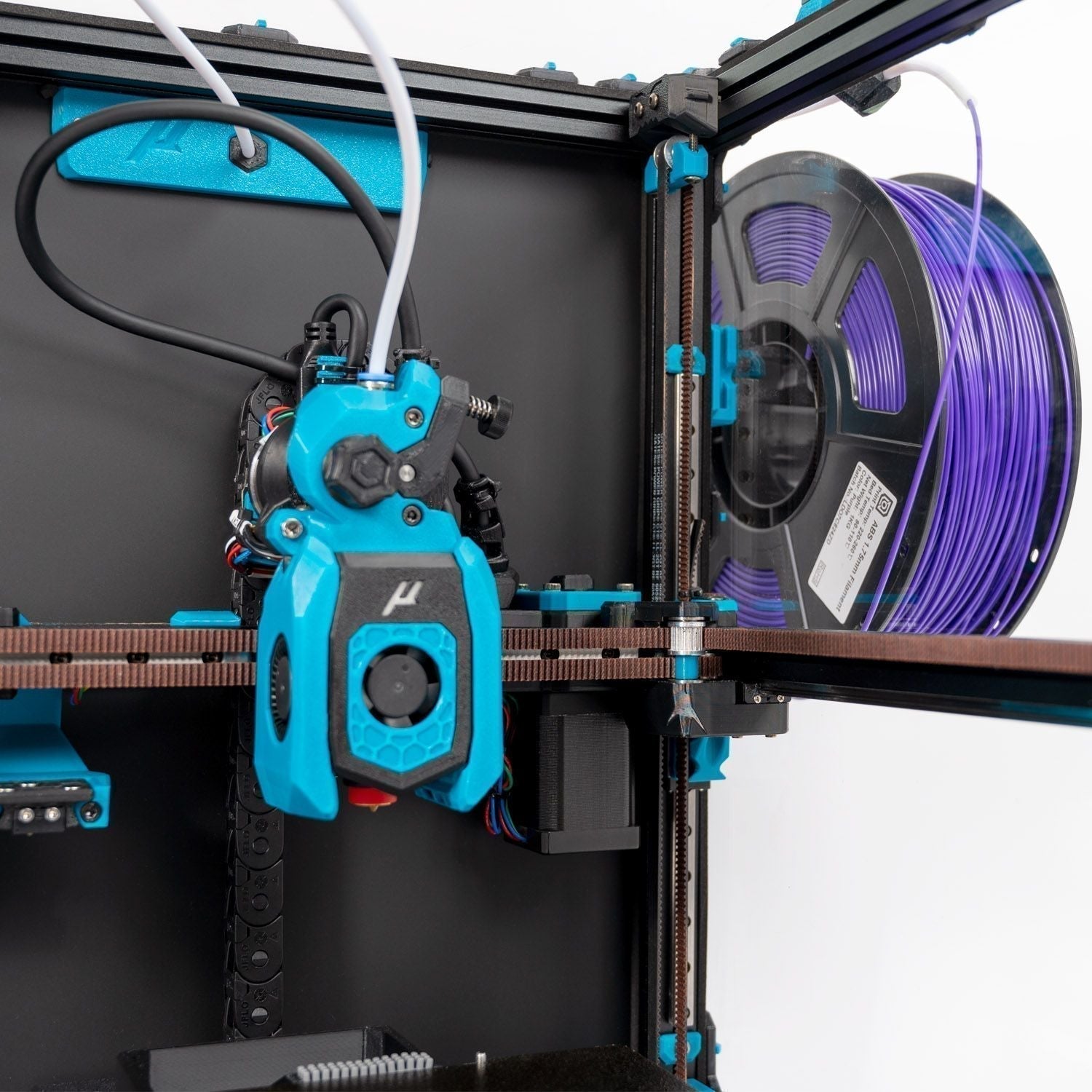
The arrival of tool changers and IDEX systems has people asking whether more complexity means a shorter lifespan. Our view: not necessarily. In a tool-changing system, each tool head is passive so no electronics, no heater cartridge, no thermistor, just a carriage with a nozzle. The active components (heater, thermistor, extruder motor) live on a single prime mover that loads each tool. The total number of failure-prone parts isn't meaningfully higher than a single-tool printer, and the passive tool heads should outlast multiple sets of consumables.
The real question isn't mechanical complexity; it's who builds it and whether the design files are public. A tool changer from an open-source project like Stealth Changer will be repairable indefinitely. A closed-source tool changer from a venture-funded startup may be a paperweight in three years.
What We’d Recommend for a Decade of Printing
If someone walks into our store tomorrow and says, "I want a printer that will definitely still be running in 2030," we point to brands with proven track records of long-haul support. Prusa is the obvious answer, you can still buy genuine parts for a MK2, and printed upgrades keep older models current. The Voron project is a different path: you build it yourself from open-source designs, and every nut and bolt is documented and non-proprietary. For those who want an appliance, Bambu Lab is the best of the closed systems, but understand that its longevity is tied to the company's continued support and goodwill.
The final truth is that a 3D printer isn't like a toaster. It's more like a bicycle. With a few tools, a source of parts, and a willingness to replace worn components before they cascade into frame damage, a good open-source printer will outlive the decade. We've got the Ender 3 and Prusa MK3 on our bench to prove it.