If a 3D printed part sits near a power supply, inside a vehicle, or inside an aircraft cabin, flame retardant stops being a nice-to-have. It becomes a hard requirement. The good news: modern FR filaments are far easier to print than most people assume. The reality check: they are not drop-in replacements for standard materials, and understanding the trade-offs before you design a part is everything.
At DREMC, we don't just sell FR filaments. We print them. We test them. And we've watched customers take FR parts all the way through internal certification to final production product or small batch run in industry applications. Here's our honest, hands-on guide to flame retardant FDM materials.
What FR Filaments Actually Feel Like on the Printer
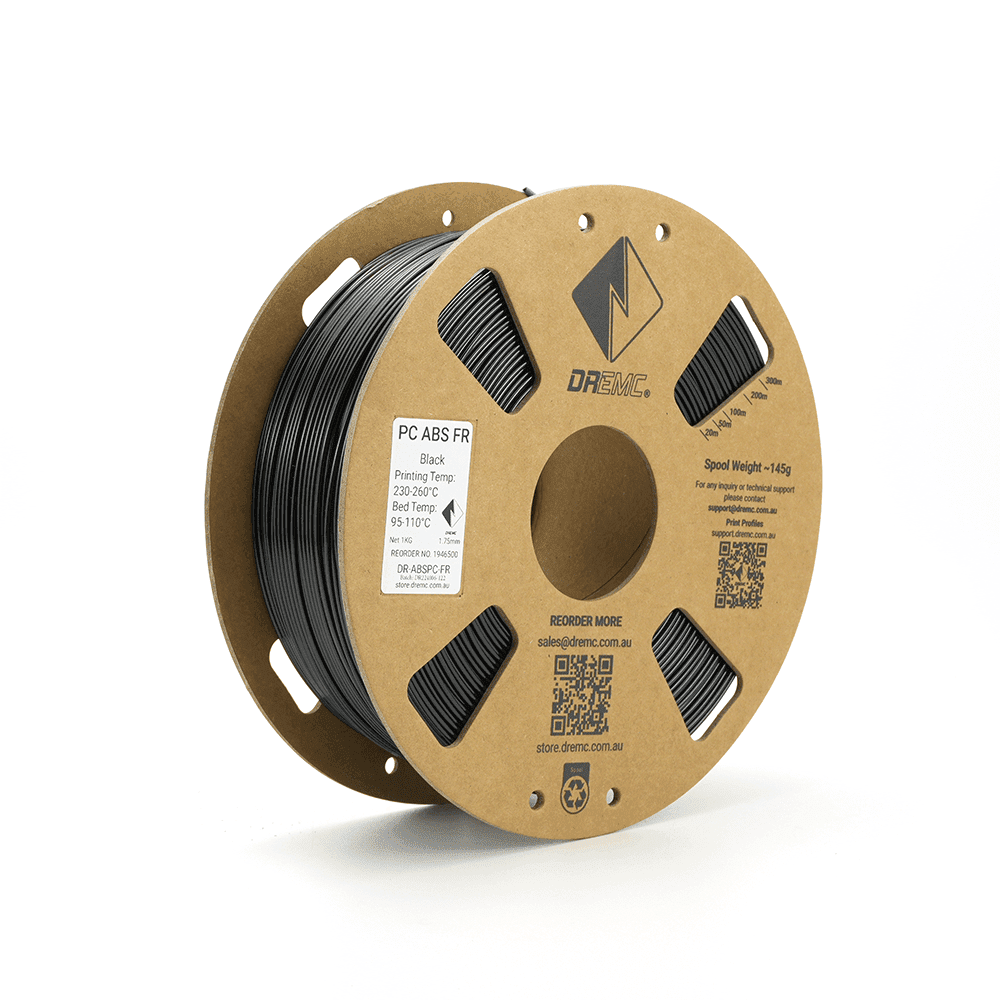
We run our own branded DREMC PC ABS FR and ABS FR regularly on our farm. The printing experience is remarkably close to standard PC ABS or ABS. The additives that provide the flame retardant are not abrasive, so if your printer is already set up for ABS or PC ABS, you won't need to swap in a hardened nozzle or change your extruder gears. That's a common fear we're happy to dispel.
What does change are the final part properties. Compared to their non-FR base materials, flame retardant blends are slightly weaker and have a lower heat deflection temperature. The difference isn't dramatic, but it matters at around 5-10c depending on the materials. If you are designing a part that will become a final product, print a test sample first and test its strength in the actual application. Do not assume the numbers from a standard ABS data sheet will carry over. They won't.
For applications where you need both inherent flame retardancy and far higher temperature resistance plus stiffness, there is PPS CF or PPS GF (polyphenylene sulfide with carbon fibre). The base resin is naturally flame retardant, no additive needed, and the mechanical properties and thermal resistance are in a different league. The catch? It costs roughly three to four times as much as our ABS FR or PC ABS FR options. If budget isn't the constraint and the part must survive extreme heat, PPS CF is the upgrade path.
Where FR Parts Are Actually Used
Our FR filament customers are rarely hobbyists printing for fun. They are manufacturers, design teams, and engineers working on custom projects that must meet specific standards, most commonly UL94. The industries that come through our door include aerospace, motorsport, and electronics manufacturing.
The pattern is nearly always the same: a team needs a prototype, a jig, or a mounting bracket fast, and they need it on site without waiting weeks for an OEM part. They print it in FR material because the part will end up near wiring, batteries, or hot components. What surprised us is how often these printed parts become the final product. Multiple companies have told us that our FR filaments, printed on their existing machines, passed their internal ISO and UL certification processes as end-use parts. The same printers that handled standard ABS or PC ABS ran the FR variant without a single hardware change.
No Modifications, No Mystery Tuning
This is the point we hammer home with every new FR customer: if your printer can print the base material (say, ABS or PC ABS) reliably, it can print the FR variant without any modifications. You do not need a special hotend, a different build plate, or exotic firmware settings. The filament is not abrasive, and the temperature requirements are essentially identical.
The only preparation we recommend is acknowledging the modest drop in mechanical strength and designing around it. We have never received a tuning support request from an FR customer. They tend to be repeat buyers who load the filament, print, and get on with their work. That alone tells you how uneventful the switch can be.
Our In-House Flame Testing
We don't rely solely on datasheets. We print test bars from the FR materials we stock and test them to the UL94 vertical burn standard. The critical criteria: the flame must self-extinguish within 10 seconds after the test flame is removed, and the material must not produce flaming drips. The ABS FR, PC ABS FR, and PETG FR on our shelf meet that standard consistently. That's the baseline we insist on before we put our name on a product.
Choosing the Right FR Material for Your Project
We deliberately keep our FR range focused on materials that already dominate commercial and industrial injection moulding. That makes the transition to FDM straightforward, because engineers and designers are already familiar with the base resins.
-
ABS FR and PC ABS FR: These require an enclosed printer with a heated bed. They are the go-to choices for electronics housings, brackets, and automotive components. The base polymers are workhorses in industry, and the FR variants slot straight into that workflow. If your project needs a balance of strength, temperature resistance, and flame retardancy, start here. The PC ABS is slightly better temperature resistant and stiffness and able to handle heat cycling much better compare to ABS FR.
-
PETG FR (Coming Soon): We added this specifically for customers who do not have an enclosed printer. It prints on an open-frame machine with minimal fuss, and it is priced competitively compared to other brands. The trade-off is lower temperature resistance than ABS FR or PC ABS FR, but for hobby projects, in-house test parts, and low-heat enclosures, it is a practical, budget-friendly option. It also provides a little extra peace of mind when you sell a printed part that might end up near electronics.
-
PPS CF: Reserved for the high-end. When the part must withstand temperatures that would soften ABS or PC ABS, and you need inherent flame retardancy plus extreme stiffness, this is the material. The cost is significantly higher, but for aerospace or under-hood automotive prototypes, it pays for itself in capability.
We price all our FR materials aggressively because we believe flame retardancy should not be a luxury add-on. If you already print ABS or PC ABS for functional parts, switching to the FR version is a small step that adds a meaningful layer of safety, especially if those parts will leave your workshop and end up in someone else's hands.